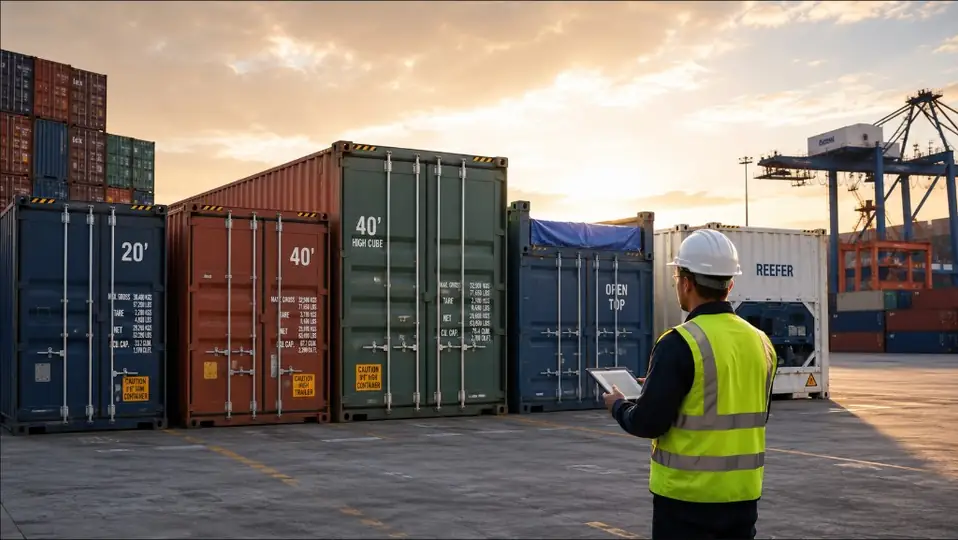
Shipping Container Dimensions: Types and Sizes
July 23, 2026 7 min read
Whether you are planning your first export shipment or have spent years in ocean freight, understanding container dimensions is essential. An error here can mean miscalculating what fits, choosing the wrong container type, or facing unexpected port costs.
This guide covers every standard container type in use today, with exact dimensions, real capacity data, and practical advice on choosing equipment for your cargo.
Why Container Dimensions Matter More Than You Think
Container dimensions directly affect:
- How many pallets or cartons you can load and in which configuration
- Total freight cost: most carriers charge by CBM or weight
- Whether cargo fits without special handling
- Compliance with inland transport weight limits
Even a 5% improvement in container utilization on a regular lane can translate into thousands of euros saved each year.
The ISO Standard: Where the Dimensions Come From
All standard shipping containers follow ISO 668:2020, which defines approved sizes using the TEU (Twenty-foot Equivalent Unit) as the base. A 20ft container equals 1 TEU; a 40ft container equals 2 TEUs.
Key distinction: always separate external dimensions (the outside of the steel frame) from internal dimensions (usable cargo space). Only internal dimensions matter for load planning.
Complete Reference Table: Dimensions for Every Container Type
| Container type | Internal length | Internal width | Internal height | Volume (CBM) | Maximum payload |
|---|---|---|---|---|---|
| 20ft standard | 5.898 m | 2.352 m | 2.393 m | 33.2 m³ | 28,180 kg |
| 40ft standard | 12.032 m | 2.352 m | 2.393 m | 67.7 m³ | 26,780 kg |
| 40ft High Cube | 12.032 m | 2.352 m | 2.698 m | 76.4 m³ | 26,480 kg |
| 20ft High Cube | 5.898 m | 2.352 m | 2.698 m | 37.5 m³ | 27,900 kg |
| 20ft Open Top | 5.888 m | 2.345 m | 2.350 m | 32.4 m³ | 20,000 kg |
| 40ft Open Top | 12.020 m | 2.345 m | 2.350 m | 65.9 m³ | 20,000 kg |
| 20ft Flat Rack | 5.620 m | 2.240 m | 2.233 m | — | 24,000 kg |
| 40ft Flat Rack | 12.050 m | 2.126 m | 1.980 m | — | 40,000 kg |
| 20ft Reefer | 5.440 m | 2.286 m | 2.216 m | 27.6 m³ | 27,400 kg |
| 40ft Reefer HC | 11.557 m | 2.286 m | 2.500 m | 66.0 m³ | 29,500 kg |
Source: ISO 668:2020 and carrier specifications (Maersk, MSC, CMA CGM). Dimensions may vary slightly by manufacturer.
20ft Container: The Workhorse of Global Trade
The 20ft is the world’s most widely traded unit—the TEU standard is named after it. Its compact size makes it ideal for dense, heavy cargo, where the payload limit is reached before the volume limit.
When to use a 20ft container
- Dense cargo: steel, machinery, construction materials, chemicals
- Small shipments that would not efficiently fill a 40ft container
- Lanes with inland weight or length restrictions
- When port costs favor smaller units
Practical example: A 20ft container loaded with steel billets usually reaches its maximum payload (28,180 kg) before its volume limit (33.2 m³). For dense cargo, a 20ft is almost always more cost-effective.
40ft Container: The Standard for Most Cargo
The standard 40ft is the default choice for most general-cargo shipments. It offers twice the floor area of a 20ft, making it ideal for light or bulky cargo where volume, rather than weight, is the limiting factor.
- Approximately 67.7 CBM of usable volume
- Up to 25 Euro pallets in one layer
- More efficient per CBM than a 20ft for light cargo
- Available at virtually every port worldwide
➡️ See also: 20ft vs. 40ft Containers—Complete Comparison
40ft High Cube: Extra Height for Bulky Cargo
The High Cube adds exactly 30.5 cm of internal height over the standard 40ft, from 2.393 m to 2.698 m. That equals roughly 9 additional m³ and permits three-high stacking of Euro pallets.
| Specification | 40ft standard | 40ft High Cube |
|---|---|---|
| Internal height | 2.393 m | 2.698 m |
| Internal volume | 67.7 m³ | 76.4 m³ |
| Maximum payload | 26,780 kg | 26,480 kg |
| Three-high Euro-pallet stacking | Not possible | Possible (cargo ≤ 96 cm) |
| Typical availability | Very high | High |
Ideal for: furniture, mattresses, lightweight textiles, and automotive parts with height requirements.
Open Top: For Cargo That Will Not Fit Through the Door
Open Top containers replace the fixed roof with a removable tarpaulin, allowing top loading by crane or gantry. They are essential for oversized, tall, or irregular cargo that cannot be loaded through a standard door.
Common uses: heavy machinery, steel coils, pipes, yachts, and cargo taller than the 2.28 m door opening.
Flat Rack: The Specialist for Heavy and Oversized Cargo
Flat Racks have a platform and end walls but no side walls or roof. Cargo can overhang the standard profile sideways and vertically, making them essential for OOG (out-of-gauge) loads.
Typical cargo: transformers, construction vehicles, offshore equipment, and industrial structures.
Reefer: Temperature Control from Origin to Destination
Reefers maintain temperatures from +25 °C to −30 °C using their own refrigeration unit. Insulation significantly reduces internal volume compared with dry containers of the same external size.
A 40ft Reefer HC has about 66 m³ of internal volume, versus 76.4 m³ for a dry 40ft HC.
How to Choose the Right Container
| Cargo type | Recommended container | Main reason |
|---|---|---|
| Dense, heavy cargo | 20ft standard | Weight limit reached before volume |
| General palletized cargo | 40ft standard | Best space/cost balance |
| Light, bulky cargo | 40ft High Cube | Extra height for three-high stacking |
| Tall or top-loaded cargo | 20/40ft Open Top | Top opening for crane loading |
| Oversized cargo | 20/40ft Flat Rack | No side restrictions |
| Food, pharma, temperature-sensitive cargo | 20/40ft HC Reefer | Temperature control |
A Note on Container Utilization
Industry data consistently shows that average global utilization for general cargo is around 62–67%. Moving from 65% to 85% utilization in a 40ft container is equivalent to loading one additional full shipment every four or five loads—without paying for another container.
Plan before loading. Use the SendContainer 3D load calculator to enter your cargo dimensions, select the container type, and obtain a real-time 3D loading plan before anything leaves your warehouse.
Related Articles
- 20ft vs. 40ft Containers: Which Should You Choose?
- Container Load Optimization: The Definitive Guide
- The “Ghost Container”: 3D Simulation and Freight Savings
Sources and References
- ISO 668:2020 — Series 1 freight containers — Classification, dimensions and ratings. International Organization for Standardization. https://www.iso.org/standard/76912.html
- ISO 1496-1:2023 — Series 1 freight containers — Specification and testing — Part 1: General cargo containers. ISO. https://www.iso.org/standard/83558.html
- ISO 6346:1995/Enm 3:2022 — Freight containers — Coding, identification and marking. ISO. https://www.iso.org/standard/20453.html
- Maersk Line — Container specifications. https://www.maersk.com
- MSC Mediterranean Shipping Company — Container types. https://www.msc.com
- CMA CGM — Container specifications. https://www.cma-cgm.com
- World Shipping Council — Containerization statistics. https://www.worldshipping.org
- Bureau International des Containers (BIC) — Container type codes. https://www.bic-code.org